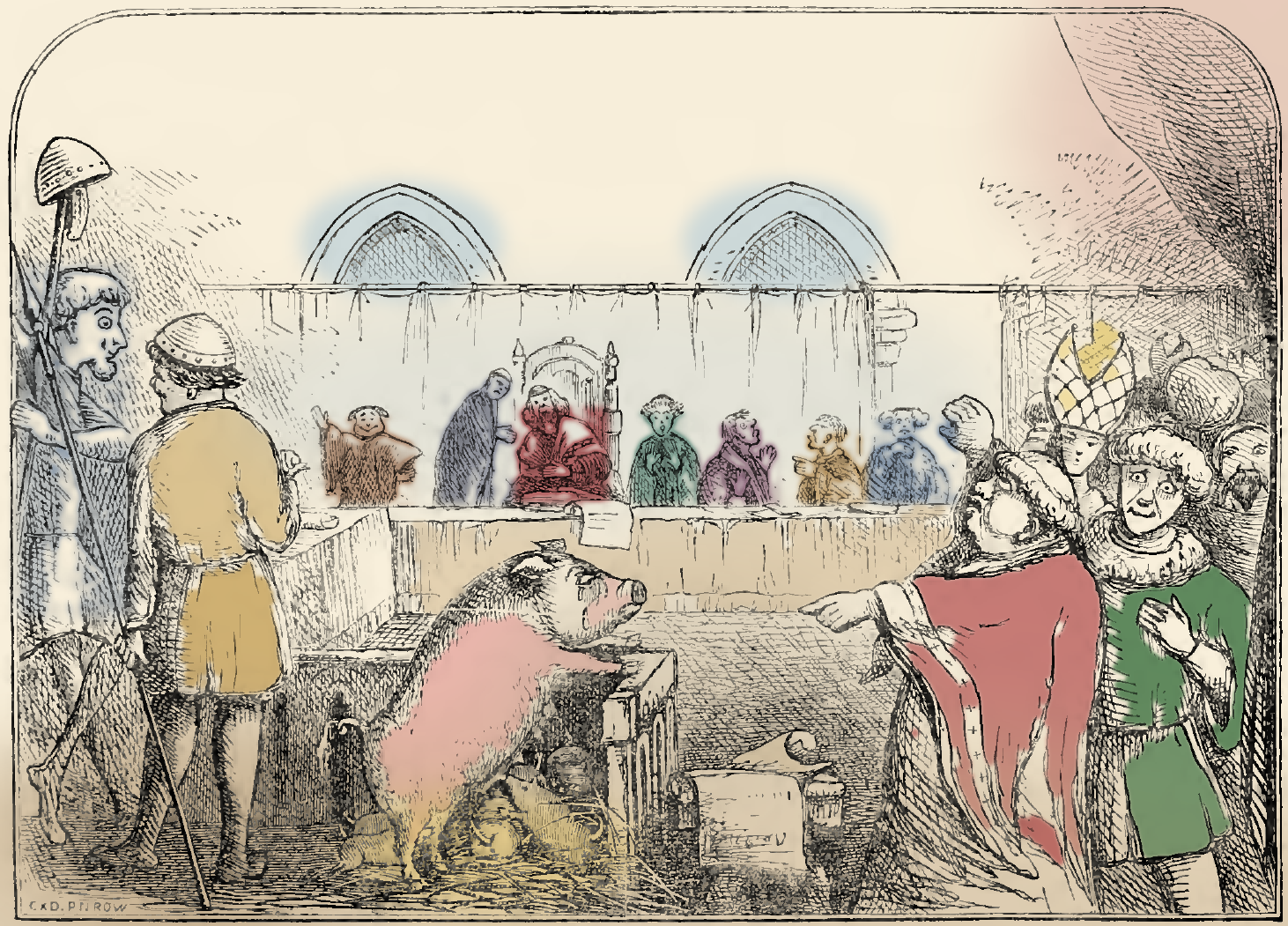
Most of us twenty-first-century urbanites have a fairly sentimental view of farm animals, precisely because so many generations have gone by since they’ve been part of our daily lives. (In South Korea, where I live, the agricultural past remains just within living memory. Perhaps that’s why so many restaurants in Seoul advertise their meat with pictures of the animals it comes from, sometimes dressed in chef’s garb and cheerfully serving up the very dishes they’re about to become.) Things were different in medieval Europe, where animals were both a necessity and a potential danger. History records many instances of serious harm done to humans by horses, bulls, and especially pigs, who seem to have had a particular tendency to turn on children.
Today we would describe the killing of a child as an inhuman act, a term that, in these cases, applies more than figuratively. As for the fate of the violently offending animal, we might imagine that it would be summarily slaughtered, but between the tenth and eighteenth centuries — and especially in the fifteenth and sixteenth centuries — it might well have been brought into a courtroom first. Though other creatures had already been subject to legal proceedings for quite some time, “the earliest recorded pig trial took place in Fontenay-aux-Roses, just outside Paris, in 1266,” writes Alexander Lee at History Today. “By the early fifteenth century, however, they had become established practice throughout Normandy and the Île-de-France,” eventually spreading beyond the border to Italy, Germany, and the Low Countries.
“As contemporary students of the Corpus iuris civilis knew, it was a basic principle of Roman law that animals could not be culpable,” Lee adds. “Lacking reason, they were incapable of harboring criminal intent and hence could not be guilty of a crime.” But in un-Roman northern France, “the administration of secular justice was still largely the concern of local seigneurs and was governed predominantly by custom rather than statute.” Thus sustained, animal trials served purposes beyond simple punishment. “For medieval people, the world was created by God in a very logical way, with animals created first, in order to serve and help human beings who were created in the image of God,” says University of Liverpool medieval European monster expert Damian Kempf, quoted in Popular Science by Anne Ewbank. In that worldview, trying and executing a pig could “restore what was broken.”
Unlike domestic animals, according to Sonya Vatomsky at JSTOR Daily, destructive mice, beetles, snails, weevils, and other vermin would be sent to ecclesiastical tribunals. “Despite being unlikely candidates for Catholicism, such creatures were punished with excommunication, not execution,” she writes, since casting them out of God’s domain would allow humans to exterminate them with peace of mind. Vatomsky also quotes economist Peter T. Leeson’s theory that the Catholic Church tried more animals when people got lax about tithing, with the aim of “bolstering citizens’ belief in the validity of Church punishments for tithe evasion.” Putting animals on trial may now strike us as grotesque, but like any alien-seeming episode of history, it also reveals the beliefs on which a past society operated — a mode of analysis that gets one wondering how far the modern United States is from giving them the right to sue.
Related Content:
Why Animals Look So Strange in Medieval Manuscripts
1,000 Years of Medieval European History in 20 Minutes
A Free Yale Course on Medieval History: 700 Years in 22 Lectures
Cats in Medieval Manuscripts & Paintings
Based in Seoul, Colin Marshall writes and broadcasts on cities, language, and culture. He’s the author of the newsletter Books on Cities as well as the books 한국 요약 금지 (No Summarizing Korea) and Korean Newtro. Follow him on the social network formerly known as Twitter at @colinmarshall.


Leave a Reply