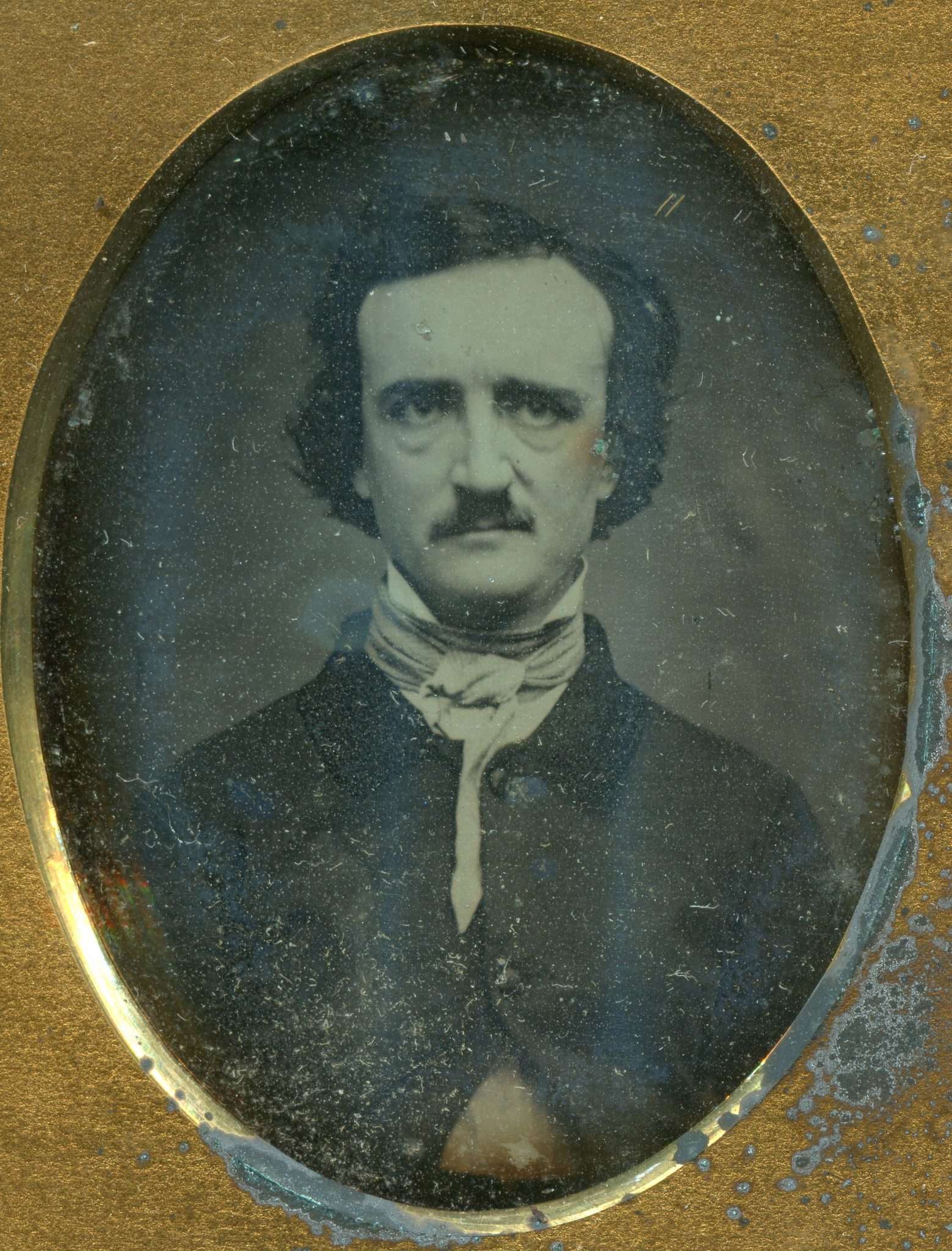
In the Halloween season, one American writer comes to mind more often than any other: Edgar Allan Poe. That owes in large part to his famously macabre tales like “The Tell-Tale Heart,” “The Cask of Amontillado,” and “The Masque of the Red Death,” written though they may have been with barely concealed contempt for their sensation-seeking magazine readership. But it also has to do with the image of the man himself. Or rather, it has to do with one image in particular: a daguerreotype photograph taken on November 9, 1848, at a Providence studio that has inspired practically every representation of Poe in popular culture since.
Known as Ultima Thule, this famous portrait was in fact just one of perhaps ten daguerreotypes for which Poe sat in his lifetime. Inventor Louis Daguerre’s early photographic process, which used silver-coated copper plates, fascinated Poe, who in an 1840 newspaper article called it “the most important, and perhaps the most extraordinary triumph of modern science.” He described its product as “infinitely more accurate in its representation than any painting by human hands,” though anyone sitting for a picture did have to sit still for minutes on end, resulting in not just the unsmiling visages we associate with nineteenth-century photography, but also in a combination of discomfort and slight blurring that can look vaguely otherworldly.
That quality may actually have enhanced the aura of Ultima Thule, which painter Michael J. Deas calls “the image of the tragic romantic poet: solemn, detached, consumed by his own wildly self-destructive nature.” It surely also made a difference that the portrait was made, in the words of poet Hervey Allen, “probably at the very hour when he looked the worst that he had ever looked in his life.” He’d been taken to the studio by a stranger with whom he’d spent the previous night binge-drinking. Just four days before that, he’d unsuccessfully attempted suicide by laudanum overdose, a rash action taken after the rejection of his marriage proposal by Sarah Helen Whitman, a widowed poet he hadn’t known long — and who would give her suitor’s immortal portrait its Latin name, borrowed from his poem “Dream-Land.”
The original daguerreotype, for which the studio probably paid the by-then notable, still perpetually hard-up Poe to sit, remained with its makers until it vanished around 1860, and its whereabouts have remained unknown ever since. But copies have allowed generation after generation of readers to behold Poe’s troubled visage when what Whitman called “all the stormy grandeur of that via Dolorosa had left its sullen shadow on his brow.” Through the drunken chaos and poverty of his life, the writer himself could see things to come. “The consequences of any new scientific invention will, at the present day exceed, by very much, the wildest expectations of the most imaginative,” he wrote, an observation true enough of photography 178 years ago, and no doubt even truer of what we use to make images today.
Related Content:
Iggy Pop Reads Edgar Allan Poe’s Classic Horror Story, “The Tell-Tale Heart”
Why Should You Read Edgar Allan Poe? An Animated Video Explains
The Mystery of Edgar Allan Poe’s Death: 19 Theories on What Caused the Poet’s Demise
7 Tips from Edgar Allan Poe on How to Write Vivid Stories & Poems
The First Photograph of a Human Being: A Photo Taken by Louis Daguerre in 1838
Based in Seoul, Colin Marshall writes and broadcasts on cities, language, and culture. He’s the author of the newsletter Books on Cities as well as the books 한국 요약 금지 (No Summarizing Korea) and Korean Newtro. Follow him on the social network formerly known as Twitter at @colinmarshall.


Interesting article, though it’s unfortunate they repeat the old canard about needing to sit still for minutes for a daguerreotype portrait. While true in the earliest days of the process, by the time the Poe portrait was taken exposures were measured in seconds, not minutes.
Romantic poets are a lot of fun to study. The problem comes with those English literature academics (some of whom are down the hall from me now) reading nonsense into things that aren’t real, such as “all the stormy grandeur of that via Dolorosa had left its sullen shadow on his brow” and “through the drunken chaos and poverty of his life, the writer himself could see things to come.”
BS. It’s a photograph of a guy coming off a drunken binge who made a few dollars to sit there. Poe was a great writer, sure, but a typical artist: lots of creativity, not much use in society. Leave it to academics who are often the same type of person, to create so much ‘depth’ to something they can’t known for certain. It beats getting a real job.
J., I must agree with you wholeheartedly. As a life long reader and collector of books your above comment is a bullseye. Having majored in literature I still can’t understand why so many professors delve into the “catharsis” of a writer or a story and an examination of an “exegesis” of what is written.
Sure, it’s nice to share what is interesting, or not interesting, about a writer or what is written; somehow, though, it takes all the fun out of things when all the technical jargon associated with things is tossed about.
Read for the sake of reading and enjoy it.
Thanks for the info on Daguerreotypes; did not know this. Nor, I think, did a lot of folks.
J, I agree and I believe it’s this far leftist ideologies prompting these “academics” to spin things anti-capitalism and pro socialism/communism.
My ancestor, William Abbott Pratt, also took images of Edgar Allan Poe in Richmond, Virginia.
The History of Pratt’s Portrait
When and Where:
In September 1849—just weeks before Poe’s death in October 1849—Poe sat for Pratt at his Virginia Sky Light Daguerrean Gallery in Richmond, Virginia.
The Sitting:
Pratt reportedly made two daguerreotypes during that session (often referred to in art history as the Thompson and Traylor daguerreotypes). These were the final photographic portraits ever taken of Poe during his lifetime.
How Pratt’s Image Relates to the Provided Article:
1. Different Photographs and Distinct Sittings:
The Article’s Focus: The provided article centers on the famous “Ultima Thule” daguerreotype. That portrait was taken on November 9, 1848, at a studio in Providence, Rhode Island, four days after Poe’s suicide attempt via laudanum overdose following Sarah Helen Whitman’s rejection.
Pratt’s Photographs: Pratt’s portraits were taken roughly ten months later (September 1849) in Richmond, Virginia.
2. Part of the Small Corpus of Poe Daguerreotypes:
The article highlights that the Ultima Thule “was in fact just one of perhaps ten daguerreotypes for which Poe sat in his lifetime.”
Pratt’s September 1849 sitters represent two of those key entries in the total count of surviving or documented daguerreotypes of Poe.
3. Shared Tragic and Sci-Tech Context:
Poe and Early Photography: The article discusses Poe’s fascination with Louis Daguerre’s process and quotes his 1840 writing praising the medium as “infinitely more accurate… than any painting.” Pratt was a key pioneer of the craft in Virginia who even patented a daguerreotype hand-coloring process.
My god, has our species truly evolved no further than such evangelical MAGA imbecility?
Most people do not know that, like many of today’s cell phone photos, daguerrotypes are mirror images, where everything is reversed. So right is left and left is right. Throughout the years, everyone (including now) has been looking at a flipped photo of Poe.
I was unaware that daguerrotypes were mirror images. Then again, almost everyone’s understanding of their own face is entirely mirror imaged. And since I once wrote a humorous(?) poem about that, I feel obliged to share it. Forgive me for straying so far from Edgar Allen, but this one might be seen as a bit “Poe-etic” (at least it rhymes!). I call it “Rorrim Rorrim”:
Mirror, mirror, on the wall,
‘Tis said you speak the truth
About my teeth, my hair, my skin,
The dimming of my youth.
But truth, to you, my silver friend,
Is relative at best.
Case in point my crooked smile
Slopes east, you’ve got it west.
And that mole you show me over here -
Well it’s really over there.
I assume that must also be true
Of how I part my hair.
I see my youth is lost, and I can’t
Blame you for that theft.
But when I find my snaggle-tooth
Sticks out the right, not left,
And these wrinkles, and this purple vein,
This ancient acne scar -
I’ll concede, they’re on my face, they’re just
Not where they really are.
It’s hard enough to search one’s self,
To see what others see.
But you, my mirror on the wall
Are the opposite of me!